Does studying tabletop role-playing games have any impact on playing tabletop role-playing games?
That is really the million-dollar question. What is the value of studying games if there is no application for those studies? Part of the difficulty in applying anything to the play of role-playing games is how hard it is to study it. John Kim's discussion of narrative in TRPGs illustrates the complex interactions compared to more traditional media:
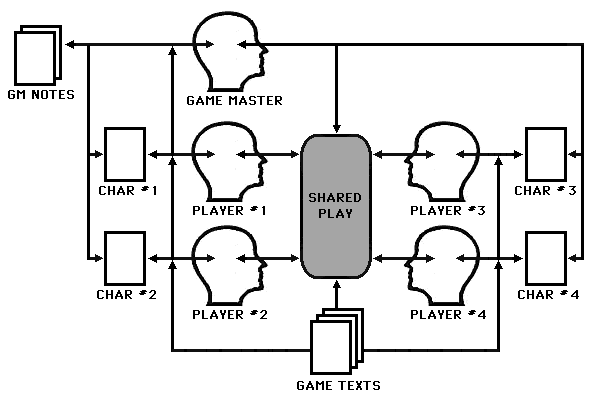
There are far more moving parts in TRPGs when it comes understanding gameplay. The play of the game exists in the discourse between the game master and the players, not in the rules of the game or the design of the adventure. All of these things inform gameplay but none of them are gameplay. Given the exponential complexity accompanying adding person after person to the shared play, we wonder if we will ever fully understand that shared experience.
If we cannot understand the shared gaming experience, does that mean we cannot understand role-playing games? Does our inability to create an atomic-level understanding mean that role-playing game studies are not worthwhile? We should be realistic about what we study and how we approach it.
Comments
Post a Comment